The paper cycle: how many times can fiber be recycled?
Cellulose fiber isn't infinite: it gets shorter and weaker with every loop. How paper recycling works, why virgin fiber is always needed and how your sorting affects fiber life.
By Zikloa TeamPublished 5 min read
Key takeaway: Paper fiber can be recycled roughly five to seven times on average. Each cycle shortens and weakens it, which is why the industry always needs some virgin fiber. How your company sorts and delivers paper directly affects how much value that fiber keeps.
How many times can paper be recycled before the fiber gives out? When a sheet lands in the recycling bin, its life isn't over; it is starting a new loop. But that loop has limits, and understanding them explains why some grades are worth more than others, what mills actually want, and what your site can do to get more out of the material.
The question has practical weight. Many international companies operating in Mexico have targets for recycled content in packaging and office supplies, and need to explain to headquarters how local fiber flows work. This guide follows the fiber from your container to a new product and shows what wears it down along the way.
How many times can paper be recycled?
The most widely accepted reference is that paper fiber can be recycled five to seven times before it becomes too short and weak to form a useful sheet. That is an average, and the real number depends on:
- Fiber origin. Long fibers, typical of softwoods, tend to withstand more cycles than short fibers from hardwoods such as eucalyptus.
- Original pulping process. Chemical pulp usually keeps fibers more intact than mechanical pulp.
- The product made in each cycle. Some products need long, strong fibers; others tolerate short ones.
- Collection quality. Wet, contaminated or mixed fiber degrades sooner.
What happens to fiber in each cycle
With every loop, fiber suffers three kinds of wear:
- Shortening. Pulping and refining cut the fibers. Shorter fibers have fewer bonding points, which makes weaker paper.
- Loss of flexibility. As fiber dries, it stiffens and loses some of its ability to swell and bond in the next cycle. Papermakers call this hornification.
- Loss of fines. The smallest particles escape with process water and leave as sludge.
That is why paper recycled many times tends to end up in products where strength or brightness matter less.
The paper journey, step by step
Once it leaves your site, paper follows a well-defined industrial process:
- Collection and sorting by grade: office paper, mixed paper, newsprint, cardboard.
- Baling and transport to the mill.
- Pulping: paper is mixed with water and agitated until it breaks down into a fiber slurry.
- Cleaning: staples, clips, plastics, sand and other contaminants are removed by screens and cleaners.
- Deinking, when the end product requires brightness.
- Refining: fibers are treated to improve bonding.
- Sheet forming, pressing and drying on the paper machine.
- Converting into a new product: boxes, packaging paper, tissue, printing paper.
Mexico's paper and packaging industry relies on a large share of recovered fiber, so the paper and cardboard your plant ships out become domestic raw material, often for the very boxes your supply chain uses.
The fiber cascade
Fiber rarely returns to the same product it came from. More often it steps down a cascade of uses based on quality:
| Fiber stage | Typical products | Demand on the fiber |
|---|---|---|
| Early cycles | Printing and writing paper, high-strength packaging | High: long, clean, bright fiber |
| Middle cycles | Corrugated board, paperboard, recycled kraft | Medium: strength over brightness |
| Late cycles | Tissue, molded packaging, dividers | Low: short fiber is acceptable |
| End of life | Mill sludge | Fiber no longer forms a useful sheet |
The cascade isn't rigid, because mills blend fibers of different ages and add virgin fiber depending on the product. But it explains why clean, well-sorted office paper is one of the most valuable grades: it has more cycles ahead of it.
Why virgin fiber will always be needed
Since fiber wears out, a system running only on recycled paper would gradually run out of usable material. Virgin fiber, much of it from plantations and managed forests, replaces what is lost in each cycle.
This has a practical implication for how you communicate. Paper is a strong example of the circular economy, but not of a perfectly closed loop. Recycling extends fiber life and reduces demand for new fiber; it does not eliminate it. Claims such as "infinitely recyclable" don't apply to paper and are worth keeping out of your sustainability materials.
Four common misconceptions about paper recycling
Understanding the fiber cycle helps clear up beliefs that still circulate in many workplaces:
- "Recycled paper is always gray or low quality." Not true. With deinking and the right fiber blend, mills make bright, strong papers; what changes is the share of recovered fiber depending on the end use.
- "If fiber wears out, recycling is pointless." The opposite. Every extra cycle is raw material that didn't have to come from wood.
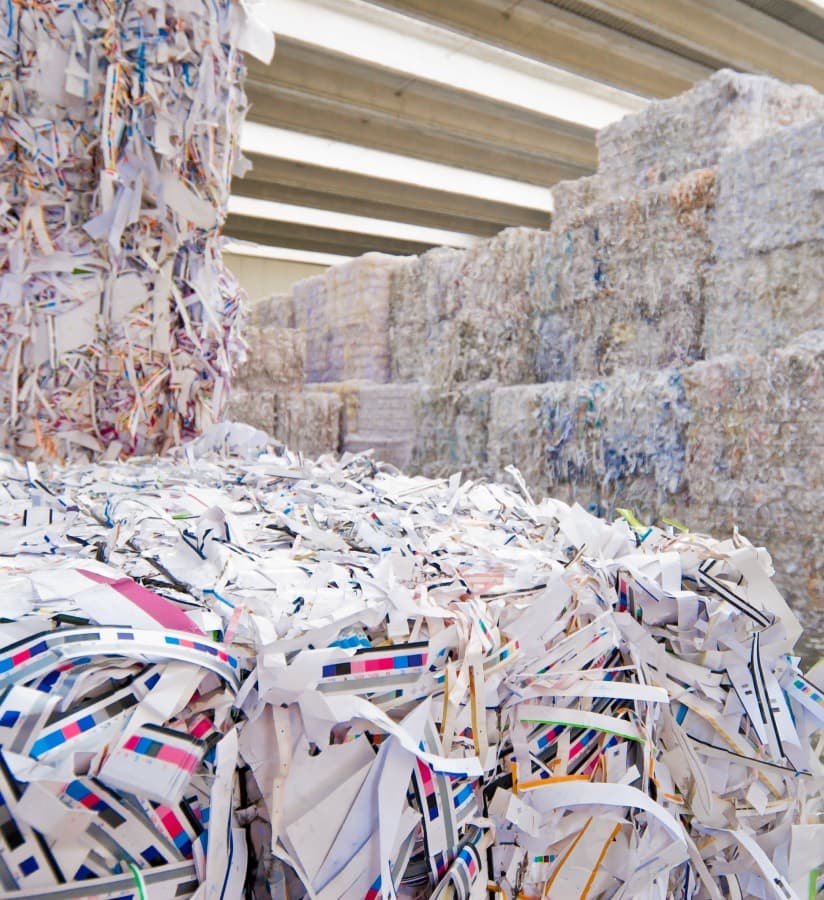
- "Shredded paper can't be recycled." It can, although it is harder to handle and usually trades at a lower grade.
- "Anything that looks like paper recycles the same way." Thermal, laminated and waxed papers behave differently in the process and can contaminate an entire load.
Folding these points into employee onboarding, in Spanish and English where needed, cuts sorting errors and improves the quality of what you ship. It also gives your sustainability team accurate language for internal campaigns, which is useful when global communications templates were written with a different recycling system in mind.
What your company can do to extend the cycle
What happens on your site determines how many useful cycles the fiber has left:
- Keep office paper separate from mixed paper and cardboard.
- Shred only what is confidential. Everything else keeps more value when recycled directly; for sensitive records, use a confidential document destruction service that guarantees the paper is recycled.
- Keep paper dry, away from humidity and rain.
- Avoid contaminants such as thermal, laminated or greasy paper. Our guide to what paper can and can't be recycled has the details.
- Work with a formal recycler that routes material to the paper industry and documents every shipment.
How Zikloa can help
Zikloa recycles paper, archived records and cardboard for businesses, with scheduled pickups, weighing on certified scales and confidential destruction when the information calls for it. Our job is to get the fiber your operation generates back to industry in the best possible condition.
If you want to get more value from the paper your company generates, contact our team and we will help you define what to separate and how to organize pickups.
- #paper recycling
- #recycled fiber
- #circular economy
- #recycled content
Frequently asked questions
Is recycled paper lower quality than virgin paper?
Not necessarily. For many uses, such as corrugated board, packaging paper and tissue, recycled fiber performs well. For high-brightness or high-strength papers, mills blend it with virgin fiber.
What happens to fiber that can no longer be recycled?
Fibers that are too short are screened out during processing and leave the mill in its sludge. Depending on the mill, that sludge is managed as waste or put to other uses.
Can we specify recycled-content paper and packaging from Mexican suppliers?
Yes. Many paper and packaging products made in Mexico contain recovered fiber. Ask suppliers for the recycled-content percentage and supporting documentation, and align it with how your corporate policy defines recycled content.